Why Late August Sun Still Burns When the Air Feels Cool
Quick Answer: Air temperature and UV strength are driven by different things. Heat depends on air masses, wind and cloud, while burning depends on sun angle and ozone path length. In late August the sun is still high enough to produce a UV index of 6 to 8 in much of the northern hemisphere, even on a day that feels pleasantly cool. Check the UV index, not the thermometer.
It was 22 degrees. There was a breeze. You wore a jacket in the morning.
And by evening your shoulders were pink.
Your skin was not confused. Your thermostat was.

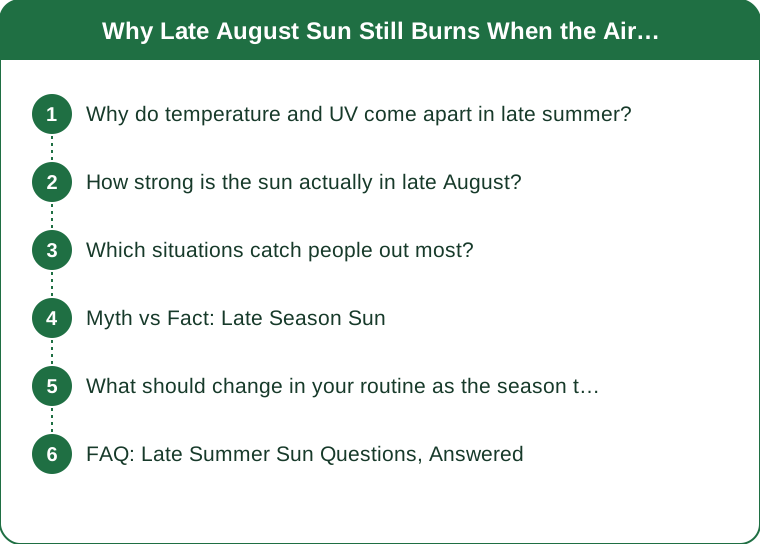
Why do temperature and UV come apart in late summer?
Because they are produced by two almost unrelated processes.
UV strength depends mainly on how high the sun sits in the sky. A higher sun means UV travels through less atmosphere, so less of it is absorbed before reaching you. It also depends on ozone, altitude, and reflection from surfaces.
Air temperature depends on where your air came from, how much the ground has warmed, wind, and cloud cover. A cool northerly airflow can drop the temperature by several degrees while doing essentially nothing to the sun’s angle.
There is also a lag. The hottest part of the year arrives weeks after the strongest sun, because land and sea take time to warm. The flip side is that as the air starts cooling in late August, the sun is still at roughly the height it was in mid-to-late April — a time of year when nobody would assume they were safe. Most people would not sunbathe in April without protection, and yet the identical UV in August feels harmless because the air is warm.
How strong is the sun actually in late August?
Stronger than the feel of the day suggests, and it varies enormously by time of day.
At mid-latitudes, a clear late-August day commonly produces a peak UV index between 6 and 8, which is classified as high to very high. On that scale, unprotected fair skin can begin to burn in 15 to 25 minutes.
The distribution through the day matters as much as the peak. Roughly half of the day’s total UV arrives between 11am and 3pm, and by 5pm the index has often dropped to 2 or 3. So an afternoon that starts at noon and an afternoon that starts at 4pm are genuinely different exposures, even in identical weather.
The practical habit is to check the UV index on your weather app the way you check the chance of rain. It takes two seconds and it is far more informative than looking out of the window, because cloud cover is a poor guide — thin high cloud can transmit the great majority of UV while making the day look grey and feel cool.
Which situations catch people out most?
Four, and they all share the property of feeling like low-risk activities.
Outdoor exercise. A morning run or a cycle feels cool because you are generating airflow. You are also outside for a sustained period at a time of day when UV is climbing, usually with sunscreen sweated off within the first half hour.
Watersports and swimming. Water reflects UV, and the cooling effect of being wet removes every sensory cue that you are burning. This is the classic late-season sailing and paddleboarding burn.
Sitting outside for lunch. An hour at a table between noon and 2pm on a mild day is a genuinely meaningful exposure, and almost nobody applies sunscreen for it.
Autumn walks at altitude or near water. UV increases by roughly 10 to 12 percent per 1000 metres of altitude, and both water and light sand reflect a substantial fraction back at you.

Myth vs Fact: Late Season Sun
Myth: If it is not hot, you will not burn. Fact: Burning is caused by UVB, which you cannot feel. What you feel as heat is mostly infrared, which has nothing to do with skin damage.
Myth: Cloud cover means you are safe. Fact: Depending on cloud type, anywhere from 30 to 90 percent of UV reaches the ground. Thin overcast is one of the most deceptive conditions there is.
Myth: A base tan from summer will protect you into autumn. Fact: A tan provides very limited protection, on the order of SPF 3 or 4, and it represents damage that has already occurred rather than a defence against future damage.
Myth: Sunscreen is a summer product. Fact: For anyone spending time outdoors, daily facial sun protection is worth continuing through September and October, when UV at midday is still meaningful at most latitudes.
Myth: Higher SPF is the main thing that matters. Fact: Quantity and reapplication matter far more than the number on the bottle. Most people apply between a quarter and half of the amount used in testing, which means an SPF 50 behaves much more like an SPF 15 in practice.
What should change in your routine as the season turns?
Less than you might think, and it is mostly about timing rather than products.
Keep the same SPF for outdoor activity. There is no reason to step down to a lower SPF in September. If you were using SPF 30 to 50 in July for a run or a swim, keep it.
Adjust the window, not the product. Concentrate protection between 10am and 4pm, and relax about early morning and late evening exposure, when the index has genuinely dropped.
Fix the quantity problem. For a face and neck, the standard guidance is roughly two finger-lengths of product. For a whole body in swimwear, about 35ml, which is far more than most people use. Reapply every two hours, and immediately after swimming or heavy sweating regardless of what the label claims.
Do not forget the parts that only see the sun in late summer. The tops of the feet once sandals come out, the back of the neck once your hair is up, and the ears are the three most commonly missed.
This is general information, not medical advice. If you have a mole that is changing in size, shape or colour, or a patch of skin that will not heal, see a qualified professional.
FAQ: Late Summer Sun Questions, Answered
At what UV index do I need sunscreen?
Most guidance suggests protection at a UV index of 3 or above. In late August that threshold is exceeded for most of the middle of the day at mid-latitudes.
Does sunscreen expire?
Yes, typically two to three years unopened, and the shelf life shortens considerably if a bottle has spent a summer in a hot car. If last year’s bottle has separated or changed smell, replace it.
Do I still need sunscreen through a car or office window?
Standard glass blocks most UVB but transmits a significant amount of UVA, which contributes to ageing and pigmentation. If you drive a lot or sit by a window, daily facial protection is worth continuing year round.
TL;DR:
- UV strength tracks sun angle, not air temperature, so a cool late-August day can carry a UV index of 6 to 8.
- Late August sun sits roughly where it does in April — an exposure nobody would treat casually in spring.
- Cloud is a poor guide, water and altitude increase exposure, and half the day’s UV lands between 11am and 3pm.
- Keep the same SPF, fix the quantity and reapplication, and protect the neck, ears and feet.
The air will keep telling you the season is over for another six weeks. Check the index instead.
Keep Reading
This article is for general informational and styling purposes only. Fit, sizing, and product availability may vary.