Why September Sun Catches Out People Who Were Fine All Summer
Quick Answer: You judge sun exposure by heat, and heat and UV come apart in autumn. Air temperature falls quickly from late August while the UV index in much of the US stays at burn-capable levels through September and into October. Cooler air also removes the discomfort cue that used to send you into the shade, so exposure time goes up as protection goes down.
All summer you were careful, or careful enough. You did not burn once in July.
Then you spent a pleasant Saturday outdoors in the third week of September, wearing nothing on your face, and came home pink.
Nothing about your skin changed. What changed is that the thing you were using to judge the sun stopped being connected to the thing that actually burns you.
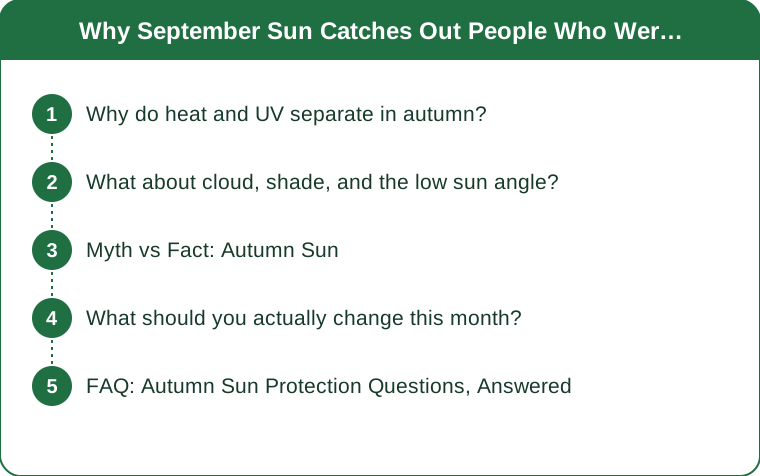
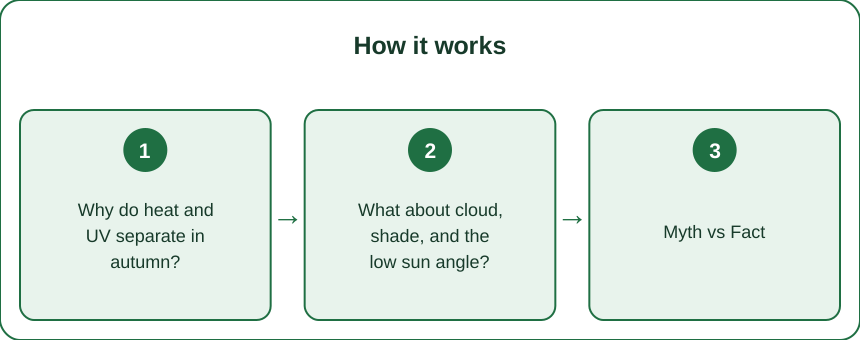
Why do heat and UV separate in autumn?
Because they come from different mechanisms with different timing.
Air temperature is driven mostly by accumulated heating - the ground and the ocean warming through the season and releasing that heat back. That is why the hottest part of the year runs weeks behind the longest day, and why late August can be hotter than late June.
UV intensity is driven by the angle of the sun and how much atmosphere the light passes through. It tracks the calendar much more directly. The UV index in mid-September at most US latitudes is roughly comparable to mid-April - a level nobody thinks of as dangerous and which burns fair skin in well under an hour at midday.
So in September you get April-level UV with August-level habits. In April people are still in long sleeves and have not yet started sitting outside. In September the furniture is still out, the evenings are still pleasant, and the sunscreen has been mentally filed under summer.
The other half of it is that heat is your warning system. Standing in strong July sun becomes uncomfortable and you move. At 72F with a light breeze, nothing tells you to move, so a twenty-minute exposure becomes ninety minutes without any decision being made.
What about cloud, shade, and the low sun angle?
All three mislead in the same direction.
Cloud. Thin or broken cloud reduces UV far less than it reduces heat and light. A bright overcast day can transmit a substantial fraction of the UV while feeling completely benign, and scattered cloud can briefly increase UV at ground level above the clear-sky value through reflection off cloud edges. Autumn has a lot of broken cloud.
Shade. Shade blocks direct sun and does much less about the UV scattered from open sky. Sitting under a tree with a wide view of the sky is meaningfully different from sitting in the shade of a building. In autumn people sit outdoors longer precisely because the shade is comfortable rather than cold.
Sun angle. The low autumn sun does two things people miss. It reduces overall UV intensity, which is genuinely protective. But it also delivers what remains to different parts of you - the face, the front of the neck, and the chest catch light at an angle they never did in July, when the sun was overhead and those areas were partly shaded by your own brow and chin.
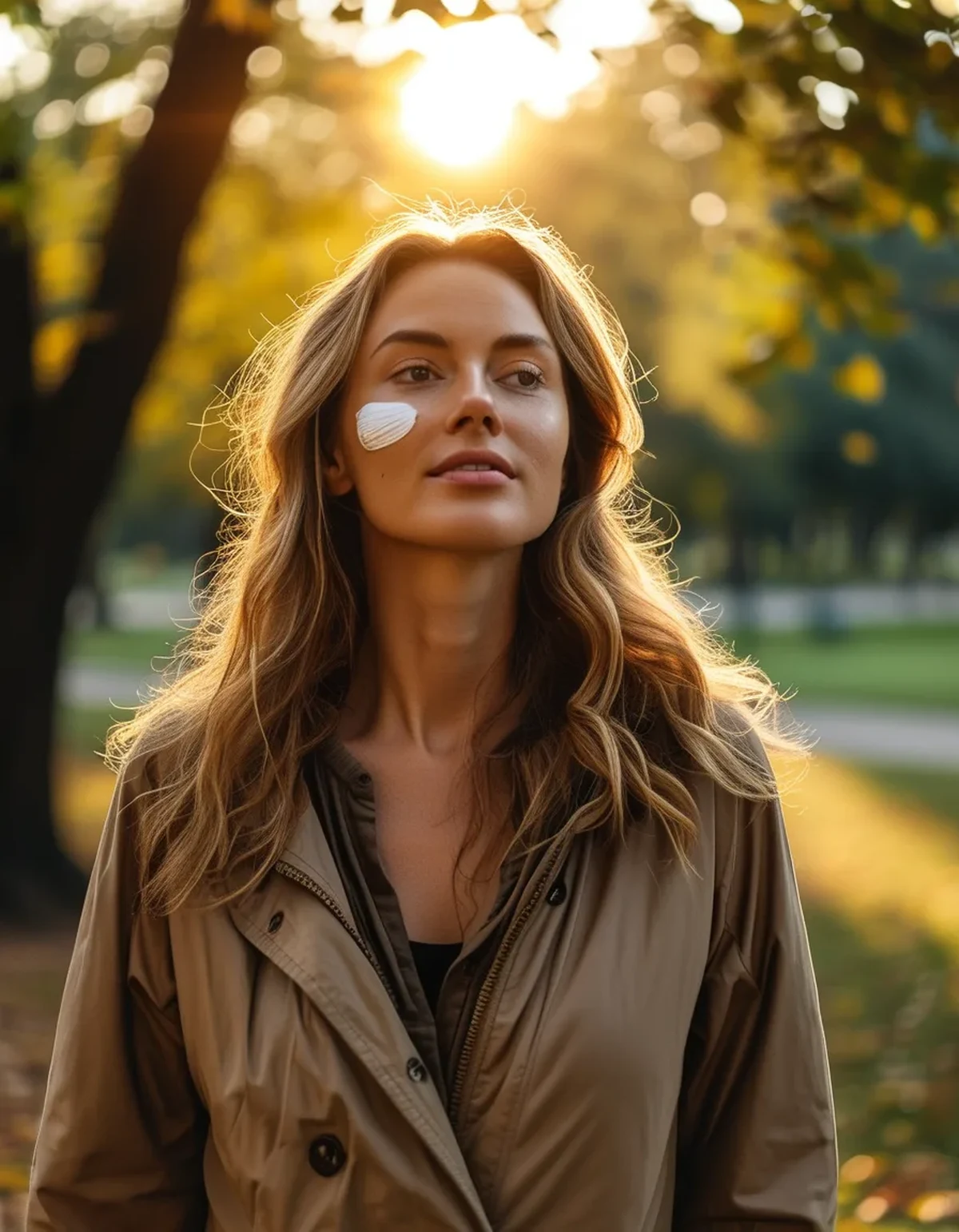
That is why autumn burns show up in an unfamiliar pattern: across the cheekbones, along the jaw, on the front of the neck. People often do not recognise it as sunburn at all, and put the irritation down to the change in weather.
Myth vs Fact: Autumn Sun
Myth: You cannot burn when it is cool. Fact: Burning is a UV dose, and skin temperature has essentially nothing to do with it. Snow sports at freezing temperatures produce some of the worst burns there are.
Myth: A summer tan protects you into autumn. Fact: A tan provides a very small amount of protection - in the region of SPF 2 to 4 - and it fades. It is not a meaningful defence and treating it as one is how people who tan easily accumulate the most lifetime exposure.
Myth: Sunscreen is only needed above a certain UV index. Fact: The commonly cited threshold of 3 is about when protection becomes clearly advisable for most skin, and much of the US sits at or above that for most of September and well into October. The threshold is not a summer boundary.
Myth: Windows protect you. Fact: Standard glass blocks UVB and lets a large share of UVA through. Autumn is when people spend more time in cars and at window desks with the low sun directly on them, which is exactly the setup for one-sided ageing.
Myth: Old sunscreen from the summer is fine. Fact: Check the date and the texture. A bottle that spent a summer in a hot car or a beach bag has been through the conditions that degrade filters fastest, and separation or a change in smell means replace it.
What should you actually change this month?
Very little, but do it deliberately rather than waiting until you burn.
Keep facial SPF in the daily routine through October at minimum. This is the one change with the highest return, because the face is the most exposed area year-round and the autumn sun angle hits it directly.
Move sunscreen out of the beach bag and into the bathroom. Location drives use far more than intention does. Sunscreen in a summer bag in a cupboard is sunscreen you will not use in September.
Reset the trigger from heat to activity. If you are going to be outdoors for more than half an hour between roughly 10am and 4pm, apply. Not if it is hot - if you are going out.
Pay attention to the new geometry. Front of the neck, jawline, cheekbones, and the tops of the hands on the steering wheel. These are the autumn spots and they are the ones summer habits do not cover.
Buy a fresh bottle now rather than in May. The one you have has been through the worst possible storage conditions, and a new bottle bought in September gets used because it is new and it is in front of you.
And check the UV index rather than the temperature forecast. Every standard weather app shows it. It takes two seconds and it recalibrates the instinct that autumn has broken.
This is general information, not medical advice. Anyone with a history of skin cancer, photosensitivity, or a medication that increases sun sensitivity should follow their clinician’s guidance rather than a seasonal rule of thumb.
FAQ: Autumn Sun Protection Questions, Answered
How late in the year does this still matter?
In the southern US, UV stays at meaningful levels year-round. In the north it drops off substantially by November. The face is worth protecting daily regardless, since the cumulative low-level exposure is what drives photoageing rather than the occasional burn.
Is SPF in makeup or moisturiser enough?
Usually not on its own, because the amount applied is far below the amount used in testing. It is a useful top-up over a proper sunscreen, and a poor substitute for one.
Do I need to reapply if I am just walking around town?
For a couple of hours in autumn conditions with no swimming or heavy sweating, a single proper application in the morning covers most people. Reapply if you are outdoors most of the day, and remember that rubbing your face and wearing a mask or scarf removes more than you think.
TL;DR:
- Temperature falls faster than UV does, so September delivers roughly April-level UV with summer-level exposure habits.
- Cool air removes the discomfort cue that used to limit your time in the sun.
- The low sun angle burns a new pattern - cheekbones, jaw, front of neck - that summer routines never covered.
- Keep facial SPF daily through October, move the bottle to the bathroom, and check the UV index rather than the temperature.
The sun did not get more dangerous in September. Your instrument for measuring it stopped working, and the fix is to stop asking how warm it feels.
Keep Reading
This article is for general informational and styling purposes only. Fit, sizing, and product availability may vary.