Why September Sunburn Catches More People Than July Sunburn
Quick Answer: UV levels fall through September but remain high enough to burn on clear days, particularly in the middle of the day and at altitude or near water. The reason late-season burns are common is behavioural: cooler air removes the heat cue that prompts people to apply and reapply, sessions get longer because the weather is pleasant, and clothing coverage often drops during exercise. Check the UV index rather than the temperature, and keep the same reapplication schedule you used in July on any clear day with a UV index of three or above.
You did not burn once all summer because you were careful.
Then you spent three hours outside on a beautiful cool September Saturday and came home with a red neck and a stripe across your forehead.
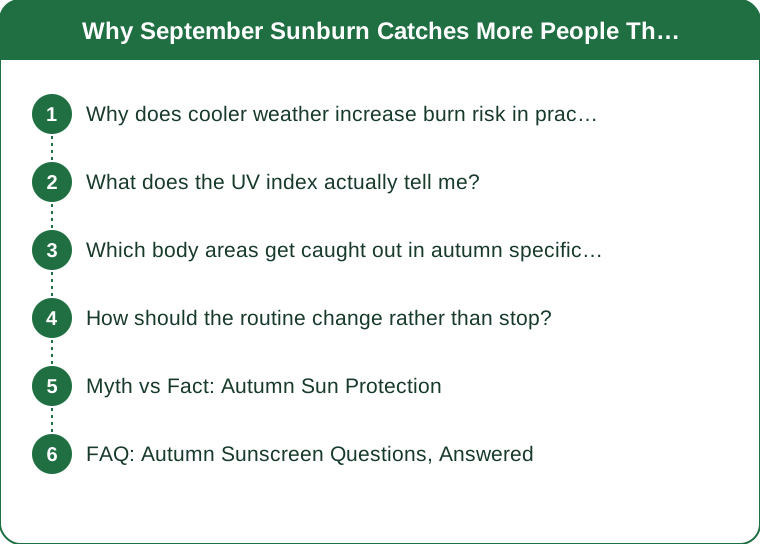
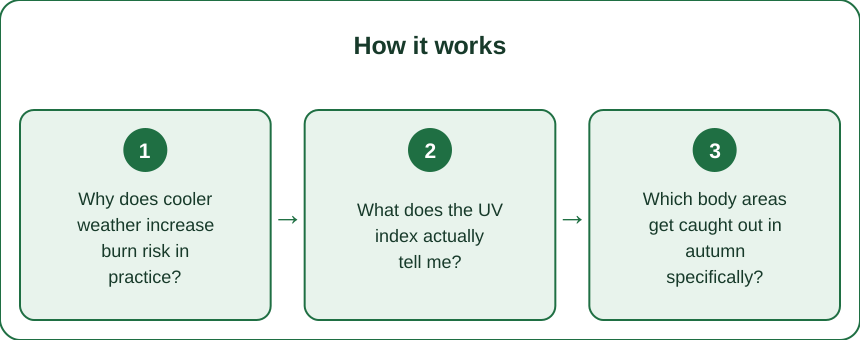
Why does cooler weather increase burn risk in practice?
Heat is the cue most people actually use, even though heat and UV are only loosely related. A cool clear day feels safe and is not.
Cooler conditions mean longer sessions. People walk further, run longer and stay outdoors more when it is twenty degrees than when it is thirty-two.
Sweat feels less like a problem, so the prompt to reapply after sweating disappears even though sweat and towel-drying still remove product.
The sun sits lower in the sky, which changes which surfaces get exposed - foreheads, noses and the front of the neck take more direct exposure than they did in midsummer.
Cloud cover is misleading. A substantial proportion of UV passes through light cloud, and hazy days produce a lot of unexpected burns.
And people stop carrying sunscreen once the beach bag goes away, which is the most mundane and most common reason.
What does the UV index actually tell me?
It is a measure of UV intensity at ground level, not a measure of temperature, and the two diverge sharply in autumn.
A UV index of three or above is generally considered the level at which protection is advised by public health guidance, and clear September days regularly reach or exceed that in much of the northern hemisphere.
It peaks around solar noon, which in early autumn is roughly the middle of the day, and the peak window narrows compared with midsummer.
It rises with altitude, which matters for hill walking and mountain sports where the air is cool and the exposure is high.
It is amplified by reflection from water, sand and light surfaces, so a cool day on the water is a high-exposure day.
Most weather apps display it, and checking it takes about as long as checking the temperature that you are already checking for the wrong reason.
Which body areas get caught out in autumn specifically?
The front of the neck and the upper chest, because a lower sun angle hits them directly rather than glancing off the shoulders.
The face below the hat brim. A cap that protected you in July protects less when the sun is lower, particularly the nose, cheekbones and the underside of the jaw near reflective surfaces.
The backs of the hands, which get more exposure as people stop wearing gloves for cold and have not started again.
The scalp along the parting, which burns readily and is almost never protected because people associate scalp burn with high summer.
Ears, particularly with hair tied back for exercise, which is another low-sun-angle problem.
And the lower legs in shorts, which are exposed for the same session length with less product applied than they got in July.

How should the routine change rather than stop?
Apply based on the UV index, not the temperature, which is a single change that fixes most autumn burns.
Keep the same reapplication interval on clear days - roughly every two hours of exposure and after heavy sweating or towelling - regardless of how cool it feels.
Move a small tube into the bag you actually use in autumn, since the beach bag is put away and the running belt or work bag is not.
Choose a broad-spectrum product and check that it has not expired, since a bottle opened last spring may be past its useful life.
Use clothing where it is easy - a light long sleeve for a long outdoor session is more reliable than reapplication you will not do.
And prioritise the mid-day hours, since the UV window narrows in autumn and avoiding the peak is more achievable than it is in July.
Myth vs Fact: Autumn Sun Protection
Myth: you cannot burn when it is cool.
Fact: burn risk is driven by UV, not by air temperature. Cool clear days at altitude are a classic burn scenario precisely because the heat cue is absent.
Myth: cloud cover means you are safe.
Fact: a significant proportion of UV penetrates light and broken cloud. Hazy overcast days produce a large share of unexpected burns because people skip protection entirely.
Myth: sunscreen is only needed in summer.
Fact: guidance generally recommends protection whenever the UV index is three or above, which occurs on clear days well outside the summer months in many locations.
Myth: a base tan protects you.
Fact: a tan provides only very limited protection and is itself a sign of UV damage. It is not a substitute for sunscreen or clothing.
Myth: higher SPF means you can apply less often.
Fact: SPF describes the protection of a properly applied layer, not its duration. Reapplication frequency is driven by rubbing, sweating and time, not by the number on the bottle. This is general information, not medical advice.
FAQ: Autumn Sunscreen Questions, Answered
What UV index means I should wear sunscreen?
Public health guidance commonly sets the threshold at three or above. Clear early-autumn days regularly reach that in the middle of the day.
How much sunscreen should I actually use?
Most people apply substantially less than the amount products are tested at. A generous layer that takes a moment to absorb is closer to correct than a thin rub-in.
Does sunscreen expire?
Yes, and products opened the previous season may be past their effective life. Check the date and the period-after-opening symbol on the bottle.
Do I need it on cloudy autumn days?
If the UV index is three or above, yes. Cloud reduces UV but does not eliminate it, and light cloud reduces it far less than people assume.
Why do I burn during exercise more easily?
Sweat and towelling remove product, sessions run long, and exercise clothing exposes areas that everyday clothing covers. Reapplication is the gap, not the product.
Should I use a separate face product?
Many people find a dedicated face formulation more comfortable and therefore actually use it, which matters more than the specific formulation. Comfort drives compliance.
When should I see a professional about a mark or a burn?
Any new, changing or non-healing skin lesion should be assessed by a qualified healthcare professional, as should a severe burn with blistering. This is general information, not medical advice.
TL;DR:
- Autumn burns are behavioural, not meteorological - the heat cue disappears while UV stays high enough to burn.
- Check the UV index rather than the temperature; three or above means protection.
- A lower sun angle exposes the neck, nose, parting and ears more than midsummer does.
- Cooler conditions mean longer sessions and less reapplication, which is the actual risk.
- Move a tube into the bag you use in autumn, since the beach bag is already put away.
The sun angle changed and your habits changed faster. This is general information, not medical advice.
Keep Reading
This article is for general informational and styling purposes only. Fit, sizing, and product availability may vary.