Do You Actually Need to Reapply Sunscreen Mid-Workout? Here's the Real Answer
Quick Answer: Yes — for any outdoor workout over 40-60 minutes involving heavy sweat, reapply SPF regardless of a ‘water resistant’ label, since water resistance is tested and rated for roughly 40 or 80 minutes of activity, not indefinitely, and heavy sweating degrades that resistance faster than swimming does in most tested conditions.
The general ‘reapply every 2 hours’ rule people know is for regular daily wear. Sweaty outdoor exercise is a different, harsher test than that rule was built around, and it’s worth understanding why before assuming your morning application is still working by hour two of a hike.
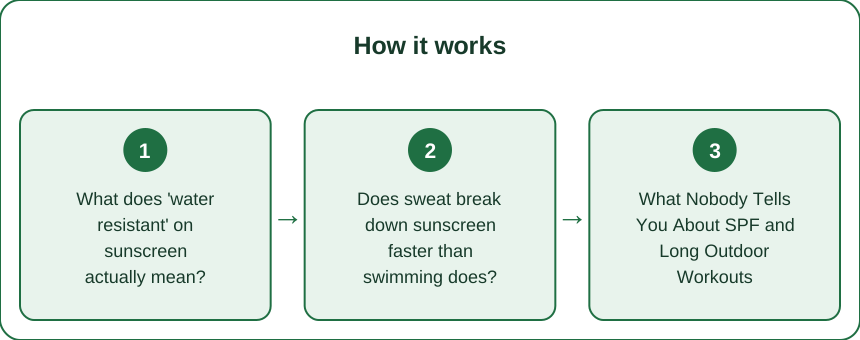
What does ‘water resistant’ on sunscreen actually mean?
It means the product was tested to maintain labeled SPF for either 40 or 80 minutes of water immersion or heavy sweating under standardized test conditions — it does not mean indefinite protection, and the label will specify which of the two durations it was tested for.
Once you’re past that tested window, protection has measurably degraded, even if the sunscreen visually still appears to be on your skin.
Does sweat break down sunscreen faster than swimming does?
In many real-world conditions, yes — sweat is a continuous, ongoing process during a workout, while swimming is often intermittent (in and out of water, drying between). A long run or outdoor class involves sustained moisture contact plus friction from clothing and touching your face, both of which physically wear down sunscreen faster than the standardized water-resistance test fully captures.

What Nobody Tells You About SPF and Long Outdoor Workouts
Beyond the water-resistance time window, friction from clothing, wiping sweat with a towel, and touching your face repeatedly physically removes sunscreen in a way that isn’t accounted for in the basic reapplication guidance most people know. A 90-minute outdoor class with a hat, a towel, and repeated face-touching can have meaningfully lower actual coverage by the end than a 90-minute swim with none of those friction points.
What’s the practical reapplication approach for workouts?
For workouts under 40 minutes, one solid application beforehand (roughly a nickel-size amount for the face alone) is generally sufficient. For anything past 40-60 minutes, especially with heavy sweat or friction from equipment or clothing, reapply at that point if possible — a stick or powder SPF is easier to reapply over makeup or mid-activity than a liquid or cream formula, and it’s worth carrying one specifically for this.
FAQ: SPF Reapplication for Exercise Questions, Answered
Does SPF in a moisturizer or foundation count for workout protection?
Generally not reliably — most cosmetic products with SPF aren’t applied in the full amount needed to reach the labeled protection level, and that gap matters more for a long, sweaty workout than for typical daily indoor wear.
Is spray sunscreen better than lotion for reapplication during a workout?
Spray or stick formats are genuinely easier to reapply over sweat and without a mirror, though lotion at the initial application still tends to give more even, reliable coverage — a common approach is lotion first, spray or stick for the reapplication.
Do you still need sunscreen on a cloudy or overcast workout day?
Yes — up to 80% of UV rays penetrate cloud cover, so an overcast outdoor workout still carries real UV exposure despite feeling cooler and less sunny.
TL;DR:
- ‘Water resistant’ means tested for 40 or 80 minutes, not indefinite protection
- Sweat plus clothing friction and face-touching remove SPF faster than the label test alone predicts
- Reapply past 40-60 minutes of sweaty outdoor activity, using a stick or powder for ease
- Cloudy days still deliver significant UV exposure — don’t skip SPF based on visible sun
Treat long outdoor workouts as their own SPF category, separate from daily wear rules — the reapplication actually matters here.
Keep Reading
This article is for general informational and styling purposes only. Fit, sizing, and product availability may vary.