Does Sunscreen Actually Expire? What the Bottle Date Really Means
Quick Answer: Sunscreen does genuinely expire — most formulas are stable for about 3 years unopened, but active ingredients degrade faster once opened, especially with heat exposure. Check the expiration date first; if there isn’t one, replace the bottle after 12 months of regular use.
That sunscreen bottle in your beach bag has been through three summers of car heat and pool trips. It still smells fine and squeezes out normally, which feels like proof it’s fine. It isn’t necessarily proof of anything.
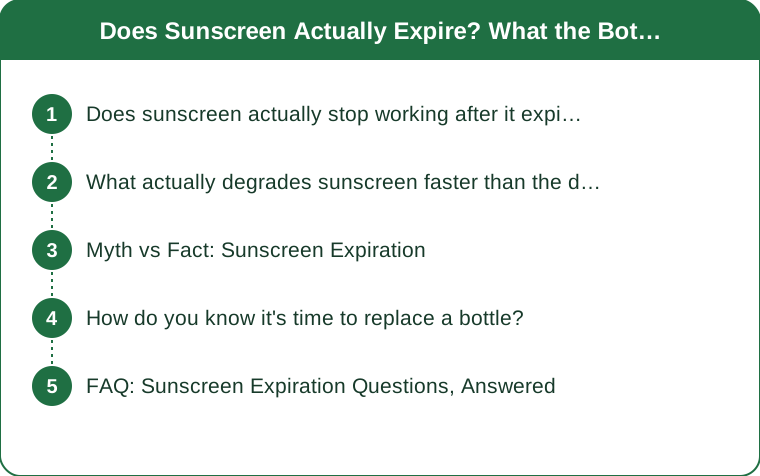
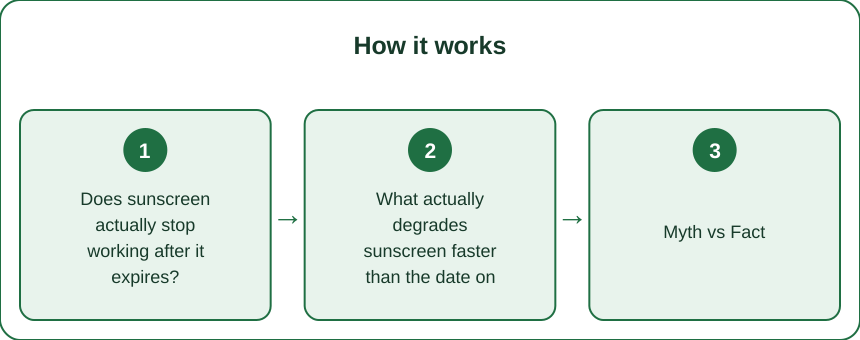
Does sunscreen actually stop working after it expires?
Yes, in a real and measurable way. Both chemical filters (like avobenzone) and mineral filters (zinc oxide, titanium dioxide) degrade over time, and that degradation lowers the actual SPF protection you’re getting, even though the product looks and smells unchanged.
By law, sunscreens sold in the US must remain effective for at least 3 years, which is why most bottles carry an expiration date around that mark — but ‘effective’ at year 3 is often meaningfully lower than the SPF printed on day one.
What actually degrades sunscreen faster than the date on the bottle?
Heat is the biggest accelerant. A bottle left in a hot car or beach bag in direct sun can degrade significantly faster than one stored at room temperature — glove compartments and pool bags are two of the worst places sunscreen lives.
Repeated opening and closing also introduces air and slight temperature swings that speed up degradation in chemical filters specifically more than mineral ones.
Myth vs Fact: Sunscreen Expiration
Myth: If there’s no visible change, it’s still fully effective. Fact: Chemical filter breakdown is invisible — no separation, smell change, or texture shift required for meaningful SPF loss.
Myth: Sunscreen without a printed date lasts forever. Fact: No date usually just means it wasn’t required at your region’s regulation level — assume a 12-month shelf life from first use if none is printed.
Myth: Mineral sunscreens don’t expire since zinc oxide is a stable mineral. Fact: The mineral particles themselves are stable, but the formula’s texture and even coverage can break down, leading to patchy, uneven application even if the raw ingredient hasn’t chemically changed.
How do you know it’s time to replace a bottle?
Check three things in order: the printed expiration date first, then texture (separation, unusual thinning, or graininess in what should be a smooth formula), then storage history — if it’s spent a summer in a hot car, replace it regardless of the date.
When in doubt, the cost of a new bottle is small compared to the cost of unknowingly wearing SPF 10 protection while believing you’re covered at SPF 50.
FAQ: Sunscreen Expiration Questions, Answered
How long does sunscreen last once opened?
Roughly 12 months of regular use for most formulas, faster if it’s been exposed to heat or direct sun during storage.
Can I use sunscreen that’s a few months past its date?
A small margin is usually low-risk for casual use, but for extended sun exposure — a beach day, a hike — err toward a fresh bottle since the protection difference matters more.
Is spray sunscreen affected differently than lotion?
Spray formulas can degrade similarly, but propellant loss over time is an additional issue — if the spray pattern becomes weak or uneven, that’s a separate sign to replace it.
TL;DR:
- Sunscreen genuinely degrades — SPF protection drops even when the bottle looks unchanged
- Heat exposure (hot cars, beach bags) accelerates degradation faster than time alone
- No date printed usually means replace after 12 months of use
- Check date, texture, and storage history before trusting an old bottle
When your sun exposure actually matters, reach for the fresher bottle — this is general information, not a substitute for a dermatologist’s guidance on your skin specifically.
Keep Reading
This article is for general informational and styling purposes only. Fit, sizing, and product availability may vary.