Why SPF 100 Isn't Twice as Good as SPF 50 (The Diminishing Returns Explained)
Quick Answer: SPF 50 blocks about 98% of UVB rays, and SPF 100 blocks about 99% — a small, diminishing gain, not a doubling of protection. Application amount and reapplication frequency matter far more than chasing a higher SPF number.
SPF numbers create an intuitive but wrong assumption — that SPF 100 protects twice as well as SPF 50. The actual math behind SPF is a curve that flattens out fast, and understanding it changes what’s actually worth prioritizing.
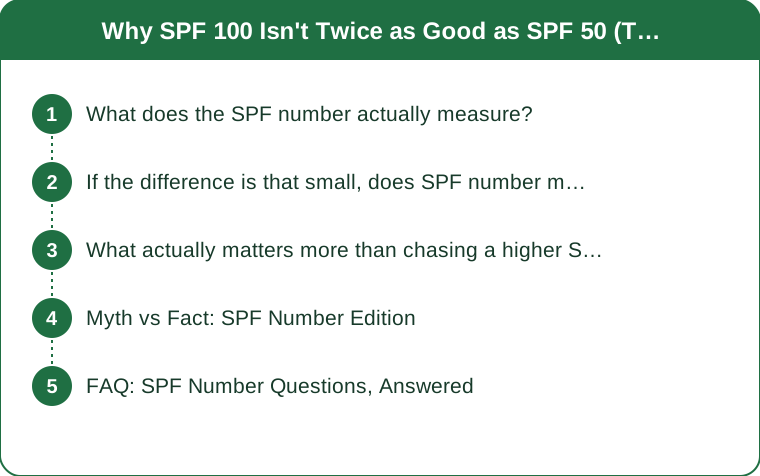
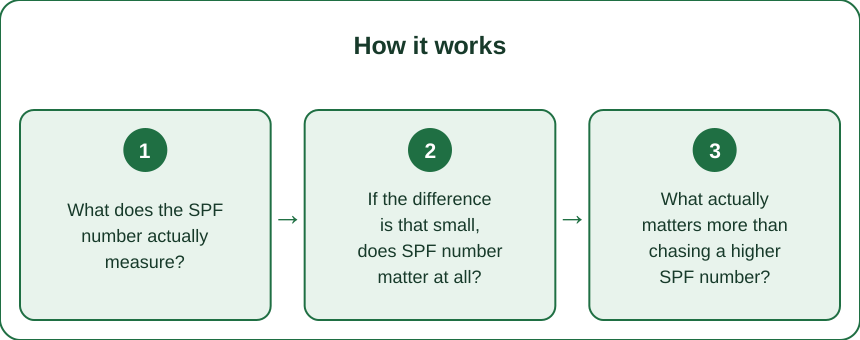
What does the SPF number actually measure?
SPF measures the fraction of UVB rays blocked, on a curve that flattens quickly: SPF 15 blocks about 93%, SPF 30 blocks about 97%, SPF 50 blocks about 98%, and SPF 100 blocks about 99%. The jump from 30 to 50 gains about 1 percentage point of blocked rays; the jump from 50 to 100 gains less than that — a small, real improvement, but nowhere close to double.
If the difference is that small, does SPF number matter at all?
It still matters, especially at the lower end — the gap between no sunscreen and SPF 30 is enormous, and between SPF 15 and SPF 30 is meaningful too. The diminishing-returns effect specifically applies once you’re already in the 30-50+ range, where higher numbers add real but small increments.
What actually matters more than chasing a higher SPF number?
Application amount — most people apply roughly a quarter to half of the amount used in official SPF testing, which in practice can cut real-world protection significantly below the labeled number, regardless of how high that number is. Reapplication every two hours, and after swimming or heavy sweating, matters just as much, since SPF protection degrades with UV exposure time and physical removal, not just clock time.
Myth vs Fact: SPF Number Edition
Myth: SPF 100 gives roughly double the protection of SPF 50. Fact: The actual difference is about 1 percentage point of blocked UVB rays — a real but small improvement, not a doubling.
Myth: A higher SPF number means you can reapply less often. Fact: All SPF levels degrade with UV exposure and time similarly — reapplication guidance (roughly every two hours) doesn’t meaningfully change based on the SPF number.
Myth: SPF measures protection from all UV damage. Fact: Standard SPF specifically measures UVB protection; broad-spectrum labeling is what confirms UVA protection is also included, which matters separately for skin aging and certain types of skin damage.
FAQ: SPF Number Questions, Answered
Should I bother buying SPF 100 if SPF 50 blocks almost as much?
Either is a reasonable choice — SPF 100 offers a small real margin, useful for extended outdoor exposure, but SPF 30-50 applied generously and reapplied on schedule performs very similarly in practice.
Does applying more sunscreen make up for a lower SPF number?
Proper, generous application matters more than most people realize — under-applying any SPF level reduces its real-world effectiveness well below the labeled number.
Is SPF 15 sunscreen basically not worth using?
It’s meaningfully better than no sunscreen at all, blocking about 93% of UVB rays, but the American Academy of Dermatology generally recommends SPF 30 or higher for daily use given the added margin at a still-reasonable formulation weight.
TL;DR:
- SPF blocks a percentage of UVB rays on a curve that flattens fast, not a linear scale
- SPF 50 blocks about 98%, SPF 100 about 99% — a small gain, not double
- Application amount and reapplication frequency matter more than the number itself
- Broad-spectrum labeling, not just SPF number, confirms UVA protection too
Apply generously and reapply on schedule — that does more for real protection than chasing the highest SPF number on the shelf.
Keep Reading
This article is for general informational and styling purposes only. Fit, sizing, and product availability may vary.