Why Sunscreen Fails Faster on Humid Days Than Hot Ones
Quick Answer: Sunscreen protects as a continuous film, and that film fails when it is diluted, lifted, or wiped away. On a humid day sweat does not evaporate, so it pools on the skin, thins the film, and migrates it into creases within roughly 40 to 60 minutes. On a dry hot day the same sweat rate evaporates and leaves the film largely intact. Humidity, not the number on the thermometer, is what shortens your reapplication window.
The day that feels sticky is the day you are least protected.

Why does humidity break the film when heat alone does not?
Because protection depends on an even layer staying where you put it, and standing water on skin is the thing that moves it.
Sunscreen works as a film. Filters sit in a layer across the surface of the skin and either absorb or scatter UV before it reaches living tissue. Gaps in that layer are not partially protected — they are unprotected, and the number on the bottle assumes an unbroken layer at a specific thickness.
On a dry day, sweat leaves the skin as vapour almost as fast as it arrives. Evaporation is the entire cooling mechanism, and when it works, the sunscreen film is left sitting on top of skin that is only briefly damp. Water-resistant formulas are built to survive exactly that.
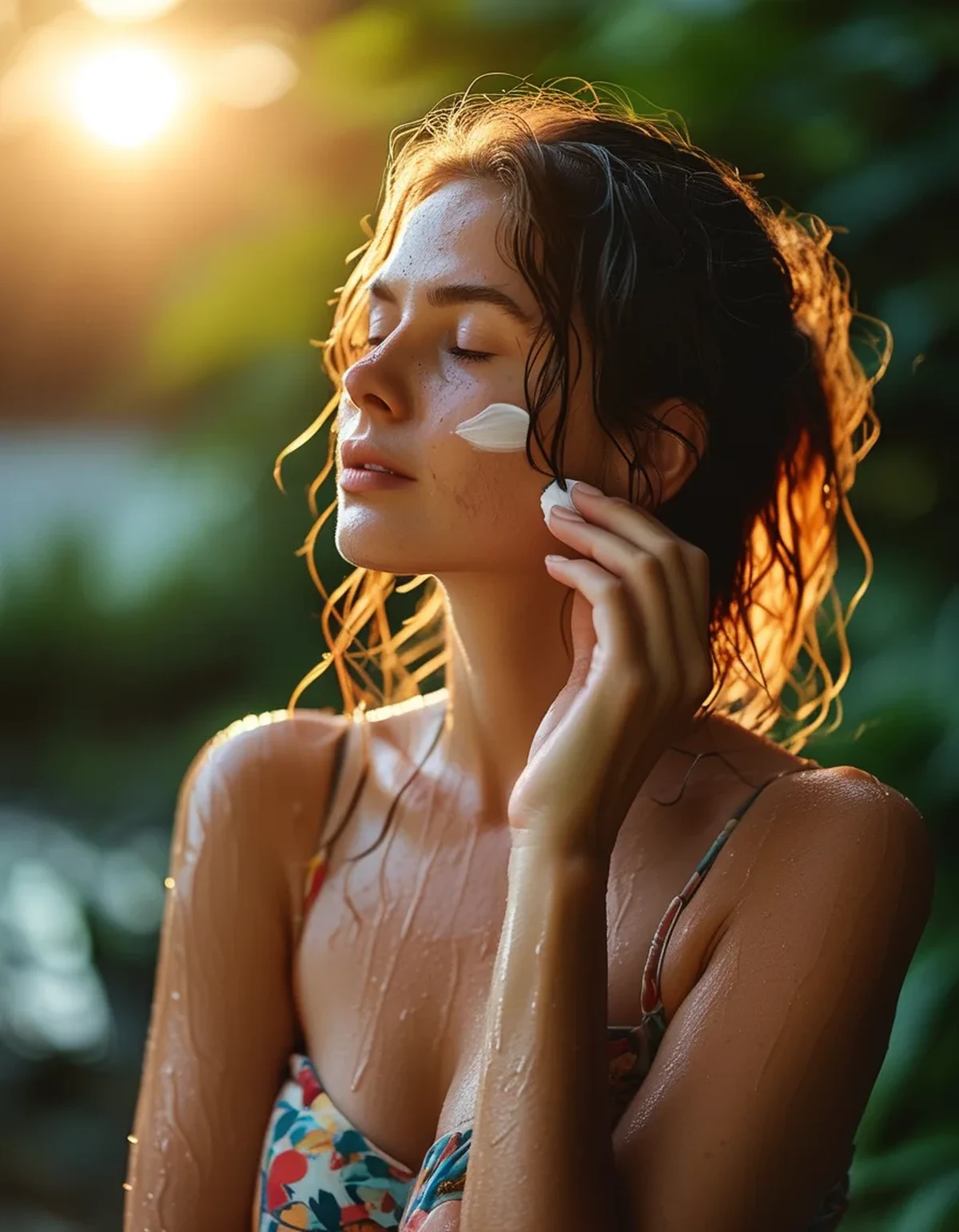
Humid air changes the physics. When the air is already close to saturated, sweat cannot evaporate, so it stays on the skin as liquid and accumulates. You end up with a layer of water underneath and around a film designed to sit on skin.
Three things then happen at once:
The film dilutes. Standing water thins the layer and reduces the effective concentration of filters per square centimetre.
The film migrates. Liquid running downward carries product with it, which is why protection fails first at the hairline, the sides of the nose, the back of the neck, and the tops of the shoulders — the places gravity moves water toward.
You touch your face more. Wiping a sticky forehead removes product mechanically, and this is the largest single loss on a humid day.
The result is a shorter effective window on a 27°C humid day than on a 33°C dry one, even though the second feels far more dangerous.
How long does protection actually last in humidity?
Shorter than the label suggests, and the label was never a clock.
Water resistance claims are tested at fixed intervals of water immersion, typically 40 or 80 minutes, and they measure how much protection survives that specific test. They do not measure continuous sweating in saturated air, and they do not account for wiping.
As a practical rule for humid conditions:
Reapply every 60 to 80 minutes outdoors, and closer to 40 minutes if you are working hard or wiping your face. That is not a manufacturer’s instruction, it is the interval at which visible film loss becomes measurable in real use.
Reapply immediately after towelling. A towel removes almost all of the product it touches, in one pass, regardless of what the bottle claims.
Use more than you think. The standard laboratory application is roughly a teaspoon per limb, and studies of real users consistently find people apply a quarter to a half of that. Under-application does not reduce protection proportionally — it reduces it disproportionately, so an SPF 50 applied thinly performs closer to the teens.
Choose the formula for the conditions. Heavier, more occlusive lotions resist dilution better than very light fluids and sprays. A light watery formula that feels wonderful in humid weather is the one most easily thinned by sweat.
Let it set before you go out. Give it 15 minutes indoors to bind to the skin. Applying at the door and walking straight into humid air means the film never gets a chance to set.
One more point people miss: cloud cover in humid weather does not remove UV. Overcast, sticky August days transmit a large fraction of UVB and nearly all UVA, and those are the days people skip the second application entirely.
Myth vs Fact: Humid Weather Sun Protection
Myth: If it is not sunny, you do not need sunscreen. Fact: Thin cloud transmits most UV, and some cloud conditions scatter it in ways that increase what reaches you at ground level. Overcast humid days are among the most common days for unnoticed burns.
Myth: Water resistant means it stays on while you sweat. Fact: It means it survived a defined immersion test. Continuous sweating in saturated air, plus wiping, is a harsher condition than the test, and the film degrades faster.
Myth: A higher SPF means you can go longer. Fact: SPF measures filtering strength, not durability. A high SPF that has been wiped off your forehead is a zero. Reapplication interval is set by film loss, not by the number.
Myth: Sprays are fine if you apply generously. Fact: Sprays are the format most likely to be under-applied, and in any breeze a large share never reaches skin. If you use one, spray into your hands and spread it.
Myth: Sweat proof sunscreen exists. Fact: It is not a permitted claim in most markets, precisely because nothing survives sweat indefinitely. Reapplication is the mechanism, and there is no formula that removes the need for it.
Myth: You only need to worry about the beach. Fact: Most cumulative exposure comes from ordinary outdoor time — commuting, walking, watching sport, waiting outside — and none of it involves anyone reapplying.
What should you do differently for the rest of the summer?
Change the timing and the format, not the SPF number.
Carry a reapplication format you will actually use. A stick for the face, a compact cushion, or a small tube in a bag. The reason people do not reapply is almost never disbelief — it is that the product is at home.
Reapply on the schedule, not on how burnt you feel. Erythema shows up hours after the damage, so skin that feels fine at 2pm tells you nothing about 11am.
Prioritise the migration zones. Hairline, part line, ears, sides of the nose, back of the neck, tops of the shoulders and feet. These fail first because liquid moves downward and because they are the last places anyone applies.
Blot before you reapply. Applying over standing sweat just floats the new layer on water. Press with a tissue, do not rub, then apply.
Use clothing as the primary layer where you can. A woven long sleeve or a broad brim removes the reapplication problem entirely for the area it covers, and in late summer a light long sleeve is often cooler in direct sun than bare skin.
Watch the late season specifically. Mid to late August still carries a high UV index across most of the northern United States in the middle of the day, and it is the point in the season when people relax their routine because the peak feels past. The sun angle has dropped slightly and the heat is less punishing, and UVB is still comfortably capable of burning you in 20 minutes.
This is general information about sun protection, not medical advice. If you have a history of skin cancer, take photosensitising medication, or notice a mole changing in size, shape, or colour, see a dermatologist rather than adjusting your sunscreen routine.
FAQ: Humid Weather Sunscreen Questions, Answered
How often should I reapply on a humid day?
Every 60 to 80 minutes of outdoor time, and every 40 if you are sweating hard or wiping your face. Reapply immediately after towelling, regardless of how long it has been.
Does sunscreen work less well when I am sweating?
The filters themselves do not weaken. The film thins, migrates, and gets wiped away, which reduces coverage. That is a coverage problem rather than a chemistry problem, and the fix is more product more often.
Is mineral or chemical better in humidity?
Mineral formulas tend to sit more visibly on the surface, which makes it easier to see when they have gone, and heavier formulas resist dilution better. Both need reapplication. Choose the one you will actually reapply.
Can I put sunscreen over sweaty skin?
Blot first with a tissue, pressing rather than rubbing, then apply. Layering over standing sweat leaves the new film floating on water and it comes off almost immediately.
TL;DR:
- Sunscreen protects as a continuous film, and humidity breaks that film by leaving sweat on the skin instead of evaporating it.
- Humid days shorten the effective window to roughly 40 to 80 minutes, well short of what most people assume.
- Failure concentrates at the hairline, nose sides, neck, and shoulders, because water runs downward and those spots get wiped.
- Blot before reapplying, carry a format you will use, and do not relax the routine just because late August feels past the peak.
Set a phone alarm for an hour from when you go outside. That single habit closes most of the gap.
Keep Reading
This article is for general informational and styling purposes only. Fit, sizing, and product availability may vary.